
Vote share is a continuous variable
Published:
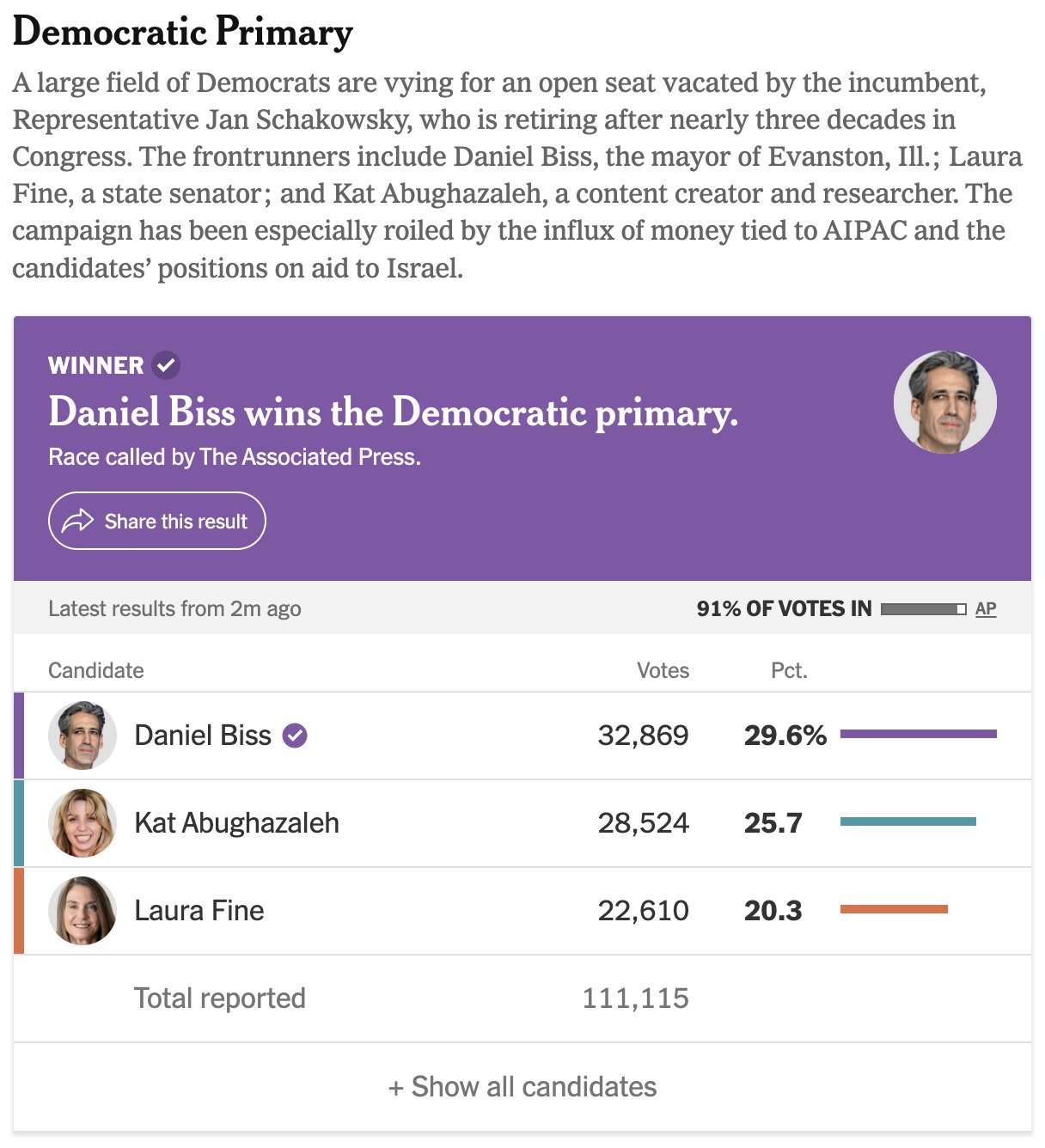
Last night, Evanston mayor Daniel Biss won the Democratic primary to replace Jan Schakowsky in Illinois’s 9th congressional district, defeating a crowded field. Kat Abughazaleh, an online content creator (she would say researcher and journalist) with no prior experience in elected office and, especially relative to the other candidates in the race, few ties to the district, came in second.
Chances are you don’t live in Illinois’s 9th congressional district and didn’t vote in the race. Which means that if you are Very Online, especially in liberal-to-left-wing circles, you are probably more familiar with Abughazaleh’s campaign than you rightfully should be. Biss ran a relatively conventional race as a frontrunner for a safe Democratic district, accumulating a wide range of endorsements from members of the Illinois Democratic congressional delegation (including the outgoing Representative Schakowsky); left-leaning interest groups such as the Illinois AFL-CIO and Sierra Club; and liberal politicians such as Elizabeth Warren, Mark Pocan, Sarah McBride, and the Congressional Progressive Caucus while focusing his campaign efforts within-district. Abughazaleh, an insurgent candidate for whom such a strategy was not viable, attempted to nationalize the race through strategies such as regularly attending anti-ICE protests (putting herself in harm’s way – both physically and legally – in the process) and vocally opposing Israel, drawing AIPAC into the race on behalf of Bushra Amiwala – another vocal critic of Israel who was polling in the single-digits – in an effort to dilute Abughazaleh’s support.
Did this strategy work? The short answer from some prominent pundits is no. On X, Nate Silver wrote, “There’s plenty of appetite for progressivism, etc., within the Democratic electorate, but the Very Online version of it doesn’t really travel well.” Lakshya Jain echoed the sentiment: “Color me shocked that the Very Online Candidate with no experience and no real campaign strategy beyond ‘get likes on the internet’ ended up losing a Democratic primary to the incumbent mayor of Evanston, Illinois.”
I don’t mean to focus on these two pundits,1 or even this particular race. This is a common form of Wednesday-morning quarterbacking after an election: a candidate lost, and therefore that candidate and/or their strategy was bad.
To be clear, Jain in particular is right here in the sense that we would generally expect a candidate like Abughazaleh to lose a primary to a candidate like Biss. But this binary outcome may not be as interesting as the fact that Abughazaleh came in second, receiving over a quarter of the vote and finishing less than four percentage points out of first, in a race that she really had no business being competitive in at all.
Wins and losses are binary, but vote share is continuous. Interpret election results accordingly.
If you’re familiar with my work, you know that I don’t mean pundits as a derogatory term. ↩